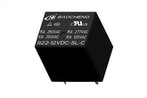
1. Overcurrent relay
Overcurrent relay, CO for short, is a relay that acts when the current exceeds its set value. It can be used for system circuit and overload protection. The most commonly used inductive overcurrent relay is made of electromagnets and aluminum or copper. The rotating disc is opposite, relying on the principle of electromagnetic induction to make the rotating disc rotate to achieve protection.
Principle of action:
The induction type overcurrent relay uses the secondary side current of the current transformer to generate a magnetic field in the relay to promote the rotation of the disc, but the current flowing must be greater than the current value of the current standard board to rotate.
2. Overvoltage relay
Overvoltage relay, abbreviated as OV, its main purpose is when the abnormal voltage of the system rises above 120% of the rated value, the overvoltage relay will act to make the circuit breaker trip to protect the power equipment from damage. The structure of the induction overvoltage relay And the operating principle is similar to the overcurrent relay, only the main coil is different.
3. Undervoltage relay
The under-voltage relay, referred to as UV, has the same structure as the over-voltage relay, except that the internal contacts and the turntable will immediately rotate when voltage is applied.
4. Grounding overvoltage relay
Grounding overvoltage relay, referred to as OVG, or grounding alarm relay, referred to as GR. Its structure is the same as that of overvoltage relay. It uses a three-phase three-wire non-grounded system and is connected to an open delta grounded grounding transformer to detect zero phase. Voltage.
5. Grounding overcurrent relay
Grounding overcurrent relay, referred to as GCR, is a high-voltage line grounding protection relay.
The main purpose:
1) Grounding overcurrent protection of high resistance grounding system;
2) Grounding protection of generator stator winding;
3) Inter-layer short-circuit protection of split-phase generators;
4) Overheat protection of grounding transformer.
6. Selective grounding relay
Selective grounding relay, abbreviated as SG, also known as directional grounding relay, abbreviated as DG, is used in non-grounded systems for the protection of power distribution lines, and can also be used in overhead lines and cable systems.
Selective grounding relay: When the zero phase sequence current is detected by the grounding voltage transformer, if the line is grounded, the selective grounding relay can accurately indicate the fault line and alarm, and select the fault line according to its needs to disconnect it, and continue Send power to normal lines.
7. Missing phase relay
Phase loss relay, referred to as OPR, or phase loss protection relay, referred to as PHR, in a three-phase circuit, when a single-phase line is broken at the power supply end, if the circuit is not immediately cut off, the motor will run in single-phase and burn out. .
8. Ratio differential relay
The ratio differential relay, RDR for short, is used as the differential protection of transformer AC motors and alternators. The overcurrent protection relays used in the past are when abnormal currents generated by external faults flow through the protection equipment. , The secondary side current is unbalanced or the characteristics of the current transformer are inconsistent. In these cases, this phenomenon will be extended several times, causing the relay to malfunction.