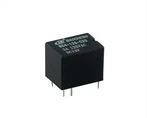
Folding working principle and characteristics
Power direction relay
When the input (such as voltage, current, temperature, etc.) reaches the specified value, the electrical appliance that makes the controlled output circuit turn on or off. It can be divided into two categories: electrical relays (such as current, voltage, frequency, power, etc.) and non-electric relays (such as temperature, pressure, speed, etc.). It has the advantages of fast action, stable work, long service life and small size. It is widely used in power protection, automation, sports, remote control, measurement and communication devices.
Electromagnetic relay
Electromagnetic relays are generally composed of iron cores, coils, armatures, contact reeds, etc. As long as a certain voltage is applied to both ends of the coil, a certain current will flow in the coil, which will produce electromagnetic effects. Under the action of electromagnetic force, the armature will overcome the pull force of the return spring and attract to the core, thereby driving the armature. The moving contact and the static contact (normally open contact) are pulled together. When the coil is de-energized, the electromagnetic attraction will disappear, and the armature will return to its original position under the reaction force of the spring, releasing the moving contact and the original static contact (normally closed contact). This pulls in and releases, so as to achieve the purpose of conducting and cutting off in the circuit. The "normally open and normally closed" contacts of the relay can be distinguished as follows: the static contact that is in the off state when the relay coil is not energized is called "normally open contact"; the static contact that is in the on state is called It is a "normally closed contact". Relays generally have two circuits, a low-voltage control circuit and a high-voltage working circuit.
Solid State Relay (SSR)
A solid state relay is a four-terminal device with two terminals as input terminals and the other two terminals as output terminals. An isolation device is used in the middle to achieve electrical isolation between input and output.
Solid state relays can be divided into AC type and DC type according to the type of load power supply. According to the switch type, it can be divided into normally open type and normally closed type. According to the isolation type, it can be divided into hybrid type, transformer isolation type and photoelectric isolation type, with the photoelectric isolation type being the most.
The solid-state relay dedicated to solid-state relays can have short-circuit protection, overload protection and overheating protection functions, and the combination logic curing package can realize the intelligent module required by the user, which can be directly used in the control system. Solid state relays have been widely used in computer peripheral interface equipment, constant temperature systems, temperature adjustment, electric furnace heating control, motor control, CNC machinery, remote control systems, industrial automation devices; signal lights, dimming, flashers, lighting stage lighting control systems; Instruments and meters, medical equipment, photocopiers, automatic washing machines; automatic fire protection, security systems, and power capacitor switches used as power factor compensation for power grids, etc. In addition, there are a large number of explosion-proof, moisture-proof, and anti-corrosion occasions such as chemical industry and coal mines. use.
Thermal Reed Relay
The thermal reed relay is a new type of thermal switch that uses thermal magnetic materials to detect and control temperature. It consists of a temperature-sensitive magnetic ring, a constant magnetic ring, a dry reed tube, a thermally conductive mounting sheet, a plastic substrate and some other accessories. The thermal reed relay does not use coil excitation, but the magnetic force generated by the constant magnetic ring drives the switching action. Whether the constant magnetic ring can provide magnetic force to the reed tube is determined by the temperature control characteristics of the temperature-sensitive magnetic ring.
Reed relay
A reed relay is a relay in which a coil generates a magnetic field to actuate the reed tube, and is a coil sensing device. Therefore, the characteristics of the reed relay, small size, light weight, fast response speed, short bounce time and other characteristics.
When a whole piece of ferromagnetic metal or other magnetically conductive material approaches it, an action occurs to open or close the circuit. It is composed of permanent magnet and reed pipe. The permanent magnet and the reed switch are fixed on a bracket that is neither magnetic nor magnetic. Take the line connecting the north and south poles of the permanent magnet as the axis. This axis should coincide or substantially coincide with the axis of the reed switch. Adjust the distance between the permanent magnet and the reed pipe from far to near, when the reed pipe just happens to move (for a normally open reed pipe, it becomes closed; for a normally closed reed pipe, it becomes open) When, fix the position of the magnet. At this time, when a whole piece of magnetically conductive material, such as an iron plate, is close to the magnet and the reed switch at the same time, the reed switch will act again and return to the state when there is no magnetic field; when the iron plate is removed, the reed switch That is, an action in the opposite direction occurs. The reed relay has a sturdy structure, sealed contacts and high durability. It can be used as a position limit switch for mechanical equipment, and can also be used to detect whether iron doors, windows, etc. are in designated positions.
Photorelay
The photorelay is a semiconductor relay that uses AC/DC and refers to a device that integrates a light-emitting device and a light-receiving device. The input side and the output side are electrically insulated, but the signal can be transmitted by optical signals.
Its characteristics are semi-permanent life, small current drive signal, high impedance insulation withstand voltage, ultra-small size, optical transmission, no contact... etc.
Mainly used in measurement equipment, communication equipment, security equipment, medical equipment... etc.
Time Relay
Time relay is a kind of control electric appliance that uses electromagnetic principle or mechanical principle to realize delay control. There are many types of it, including air damping type, electric type and electronic type.
Air damping time relays are often used in AC circuits, which use the principle of throttling air through small holes to obtain time delay action. It is composed of three parts: electromagnetic system, delay mechanism and contacts.
Time relays can be divided into two types: power-on delay type and power-off delay type.
The air damping time relay has a large time delay range (with 0.4~60s and 0.4~180s), it has a simple structure, but its accuracy is low.
When the coil is energized (voltage specifications are ac380v, ac220v or dc220v, dc24v, etc.), the armature and pallet are attracted by the iron core and move down instantaneously, making the instantaneous action contact on or off. But the piston rod and lever cannot fall with the armature at the same time, because the upper end of the piston rod is connected to the rubber film in the air chamber. When the piston rod starts to move downward under the action of the release spring, the rubber film will be concave downward. The air in the air chamber becomes thinner, causing the piston rod to be damped and slowly descend. After a certain period of time, the piston rod descends to a certain position, and the delay contact action is pushed through the lever to make the moving-break contact open and the moving-close contact closed. The period from when the coil is energized to when the delay contact completes the action is the delay time of the relay. The length of the delay time can be changed by adjusting the size of the air inlet hole of the air chamber with a screw.
After the suction coil is de-energized, the relay relies on the recovery spring to recover. The air is quickly expelled through the air outlet.
Intermediate relay
Features of intermediate relay:
The relay is composed of multiple high-quality sealed small relays with low coil voltage, which is moisture-proof, dust-proof, uninterrupted, and has high reliability. It overcomes the shortcomings of electromagnetic intermediate relay wires that are too thin and easy to break; low power consumption and low temperature rise , No need to attach high-power resistors, it can be installed and connected at will; the relay has large contact capacity and long working life; after the relay is activated, there is a light-emitting tube indicator, which is convenient for on-site observation; the delay only needs to be set by the dial switch on the panel , The delay accuracy is high, and the delay range can be arbitrarily set between 0.02-5.00S.