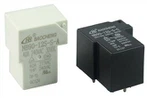
Intermediate relays are used in relay protection and automatic control systems to increase the number and capacity of contacts. They are also used to transmit intermediate signals in control circuits. The structure and principle of the intermediate relay are basically the same as that of the AC contactor. The main difference from the contactor is that the main contact of the contactor can pass high current, while the contact of the intermediate relay can only pass small current, so it can only be used In the control circuit, it generally does not have a main contact. Because the overload capacity is relatively small, all it uses are auxiliary contacts, and the number is relatively large. The definition of the new national standard for the intermediate relay is K, which is generally DC power supply, and a few use AC power supply.
The principle of the intermediate relay is the same as the AC contact, which is composed of a fixed iron core, a moving iron core, a spring, a moving contact, a static contact, a coil, a terminal and a shell. When the coil is energized, the moving iron core acts to pull in under the action of electromagnetic force, driving the moving contact to move, so that the normally closed contact is separated and the normally open contact is closed; the coil is de-energized, and the moving iron core drives the moving contact under the action of the spring Reset.
1. Classification of intermediate relays
There are two main delay modes of the intermediate relay, namely the power-on delay and the power-off delay. The installation methods are mainly divided into fixed, protruding, embedded, and guide rail types. It generally does not have a main contact, because the overload capacity is relatively small. So all it uses are auxiliary contacts, and the number is relatively large.
There are many types of intermediate relays. According to the structure, there are two types of electromagnetic relays and static relays:
1. Static intermediate relay:
The static integrated circuit type intermediate relay adopts the principle structure of integrated circuit and has good anti-vibration. It is suitable for various power relay protection and automatic control devices to increase the contact capacity and number of contacts for protecting and controlling the hoist. The static intermediate relay is composed of electronic components and precision small relays, etc., and is the first choice for the renewal of power series intermediate relays.
1) The static intermediate relay is more precise in use, moisture-proof, dust-proof, uninterrupted, and has high reliability. It overcomes the shortcomings of the electromagnetic intermediate relay that the wire is too thin and easy to break.
2) Low power consumption, low temperature rise, no need for external high-power resistors, easy to install and connect at will.
3) Large relay contact capacity and long working life.
4) After the relay is activated, there is a light-emitting tube indicator, which is convenient for on-site observation.
5) High insulation withstand voltage level. The contact capacity is large, and the contact resistance is small.
2. Electromagnetic intermediate relay
The electromagnetic intermediate relay is a traditional old-fashioned relay. As long as a certain voltage is applied to both ends of the coil, a certain current will flow in the coil, which will produce electromagnetic effects. The armature will overcome the return spring under the action of electromagnetic force. The pulling force is attracted to the iron core, thereby driving the moving contact and the static contact of the armature to attract. When the coil is de-energized, the electromagnetic attraction will also disappear, and the armature will return to its original position under the reaction force of the spring, releasing the moving contact and the original static contact. This pulls in and releases, so as to achieve the purpose of conducting and cutting off in the circuit. It is a customary product used by our customers. Delixi Electric CDZ9/CDZ9(s) series of small electromagnetic relays are produced on a fully automated assembly line, which guarantees quality and quantity, and has the characteristics of stable performance, high reliability, large capacity, environmental protection and safety.
Generally, different functions are added to the static and electromagnetic intermediate relays to meet the needs of customers. The following introduces several commonly used intermediate relays:
Intermediate relay with delay
The time delay intermediate relay is mainly used in various protection and automatic control circuits of DC or AC operation as an auxiliary relay to increase the number of contacts and the capacity of contacts. On the basis of the original intermediate relay, a delay function is added to freely adjust the required time range. According to customer requirements, it can be divided into power-on delay function and power-off delay function. In actual operation, it also becomes adjustable delay action and adjustable delay return.
With holding intermediate relay
It usually refers to the intermediate relay that is operated by voltage and maintained by current. It is generally used for the anti-trip function of the circuit breaker in the complete cabinet. There are also intermediate relays for current action and voltage maintenance.
Second, the role of intermediate relay
In industrial control circuits and current household appliances control circuits, there are often intermediate relays. For different control circuits, intermediate relays have different functions. The common functions of the intermediate relays in the circuit are as follows.
1. Replace small contactors
The contact of the intermediate relay has a certain load capacity. When the load capacity is relatively small, it can be used to replace small contactors, such as the control of electric rolling gates and some small household appliances. This can not only achieve the purpose of control, but also save space and make the control part of the electrical appliance more delicate.
2. Increase the number of contacts
In the circuit control system, adding an intermediate relay to the circuit will not only not change the control form, increase the number of contacts, but also facilitate maintenance. Delixi Electric CDZ9 series of small electromagnetic relays have complete specifications, with single, 2, 3, and 4 contact sets. One relay can control multiple sets of circuits.
3. Increase contact capacity
Although the contact capacity of the intermediate relay is not very large, it also has a certain load capacity, and the current required for its drive is very small, so the intermediate relay can be used to expand the contact capacity. The intermediate relay is used in the control circuit to control other loads through the intermediate relay to achieve the purpose of expanding the control capacity. The rated current of Delixi Electric's small electromagnetic relays ranges from 3A to 60A, which is in line with most market applications and meets the needs of different usage scenarios.
4. Convert contact type
In the industrial control circuit, an intermediate relay can be connected in parallel with the original contactor coil, and the normally closed contact of the intermediate relay can be used to control the corresponding components, and the contact type can be changed to realize the need to use the normally closed contact of the contactor to achieve control. Purpose. Delixi Electric CDZ9(s) series of small electromagnetic relays are equipped with LED indicator lights as standard, which can change the status of the indicator lights during the contact switching action. So you can understand the contact status more intuitively.
5. Used as a switch
In some control circuits, the on and off of some electrical components often use intermediate relays, which are controlled by the opening and closing of their contacts. Such as the common automatic degaussing circuit in color TV or display, the triode controls the on and off of the intermediate relay, so as to control the on and off of the degaussing coil.
6. Conversion voltage
In the industrial control circuit, the voltage in the control circuit is DC24V, and the solenoid valve coil voltage is AC220V. Installing an intermediate relay can separate DC and AC, high voltage and low voltage, which is convenient for future maintenance and is conducive to safe use. Delixi Electric CDZ9(s) series of small electromagnetic relays have a variety of coil control voltage specifications, and red/blue buckles are used to distinguish AC/DC voltage coils. It can greatly reduce product configuration time and reduce the error rate of complete wiring.
7. Eliminate interference in the circuit
In industrial control or computer control circuits, although there are various interference suppression measures, the interference phenomenon still exists more or less. Adding an intermediate relay inside can achieve the purpose of eliminating interference.
Three, the intermediate relay fault handling method
Since the structure of the intermediate relay is basically the same as that of the contactor, the common faults, diagnosis and countermeasures of the contact part and the electromagnetic system can refer to the relevant part of the contactor. It only needs to be pointed out that: the contacts of the intermediate relay are prone to false connection faults. This fault often occurs during the working period of the electrical control. It may not happen frequently or fixedly, so it is difficult to catch and make the fault difficult to judge. But occasionally, it may cause major accidents. The reason for this kind of failure is due to the change of the contact resistance of the control loop, which makes the actual voltage at both ends of the electromagnetic electric appliance coil lower than 85% of the rated voltage, so that the iron core cannot be pulled in and the circuit is out of control. The best way to eliminate the fault is:
1. Try to avoid using a low voltage of 12V and below as the control voltage, because in this low-voltage circuit, the contact failure is most likely to occur.
2. When the control circuit adopts 24V as the control voltage, parallel contacts should be used to improve its working reliability.
3. When the control loop must use low voltage control, it is better to use 48V.
4. It is better to use 110V and above voltage as the rated control voltage for the control loop, which can effectively prevent the phenomenon of contact virtual connection.