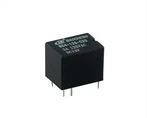
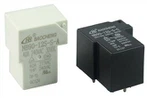
Contact failure type
The contact is the most important structural part of the relay. The service life of the contact is affected by the contact material, the voltage and current value on the contact (especially the voltage and current waveforms when it is on and when it is off), the type of load, The influence of switching frequency, environmental conditions, contact form, contact bounce phenomenon, etc. Contact failures are mostly caused by failure phenomena such as material transfer, adhesion, abnormal consumption, and increase in contact resistance of the contact.
Contact material
Contact failures are closely related to contact materials. When selecting relays, matching and screening should be performed according to actual application scenarios and material characteristics.
Precautions related to contact load
Generally, the size of the resistive load is recorded in the product manual, but the load is more or less inductive or capacitive in actual use, so a more reliable way is to test and confirm in the actual contact circuit.
The minimum load recorded in the product manual is not the standard lower limit that the relay can reliably switch. This value is different due to the on-off frequency, environmental conditions, changes in the required contact resistance, and absolute values. Contact load related
Excessive voltage easily leads to increased contact consumption and material transfer.
Under the same current, the direct current (DC) voltage value that the relay can reliably switch is much lower than the alternating current (AC) voltage value, because the alternating current has a zero point (the point where the current is zero).
Excessive current impact can easily cause the contacts to stick and not be disconnected, and increase the consumption of contacts.
Other matters needing attention
When the two sets of contacts are connected in parallel, the reliability of the connection can be improved, but the load capacity cannot be improved, because the two sets of contacts cannot be opened or closed at the same time.
Avoid synchronizing the contact action with the phase of the AC load. During synchronization, if the contacts are always turned on or off when the load voltage is high, it will increase the adhesion or material transfer of the contacts, which will cause the relay to fail prematurely.
Both the inrush current and the reverse voltage of the inductive load will cause great damage to the contacts and significantly shorten the service life of the relay. Therefore, proper use of the contact protection circuit can increase the service life of the relay.
The protection circuit has parallel resistance capacitor method, parallel diode/zener tube method, parallel varistor method, series inductance capacitor method and so on.
Applying rated voltage to the coil is the basis for the normal operation of the relay. When only applying a voltage exceeding the operating voltage, the relay can work, but considering the changes caused by power supply voltage fluctuations, temperature rise, etc., which will affect the normal operation of the relay, the rated voltage must be applied to the coil.