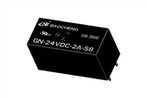
1. Measure the coil resistance: use a universal meter to measure the resistance of the relay coil in the R×10Ω gear to determine whether the coil is open. The resistance value of the relay coil has a very close relationship with its working voltage and working current, and its working voltage and working current can be calculated by the resistance value of the coil.
2. Measuring contact resistance: Use the resistance file of a universal meter to measure the resistance of normally closed contacts and moving points. The resistance value should be 0; and the resistance value of normally open contacts and moving points is infinite. From this, it can be distinguished which is a normally closed contact and which is a normally open contact.
3. Measure the pull-in voltage and pull-in current: find an adjustable regulated power supply and an ammeter, input a set of voltage to the relay, and connect an ammeter in the power supply loop for monitoring. Slowly increase the power supply voltage. When you hear the pick-up sound of the relay, write down the pick-up voltage and current. For accuracy, you can try several times and find the average value. Measure the release voltage and release current: also connect the test as above. When the relay is pulled in, gradually reduce the power supply voltage. When you hear the relay release sound again, write down the voltage and current at this time. You can also try more Several times to obtain the average release voltage and release current. Under normal circumstances, the release voltage of the relay is about 10-50% of the pull-in voltage. If the release voltage is too small (less than 1/10 of the pull-in voltage), it cannot be used normally, which will threaten the stability of the circuit. Make the work unreliable.